


Global Engineering in practice
HPI High Performance Industrietechnik GmbH | Gregor Kücher, Senior Sales Manager & Customer Service
Global Engineering in practice
US-site expands its capacity with a new HPI horizontal casting line.
In today’s industrial landscape, success depends not only on technical expertise but also on effective intercultural collaboration. This current project between HPI and a U.S. customer demonstrates how international teamwork can turn ambitious ideas into reality.
Experts from Austria, the United States, and India worked together seamlessly, combining their strengths to achieve this success. The project was driven on one hand by technical know-how and structured processes, and on the other by a pragmatic approach paired with flexible and creative problem-solving.
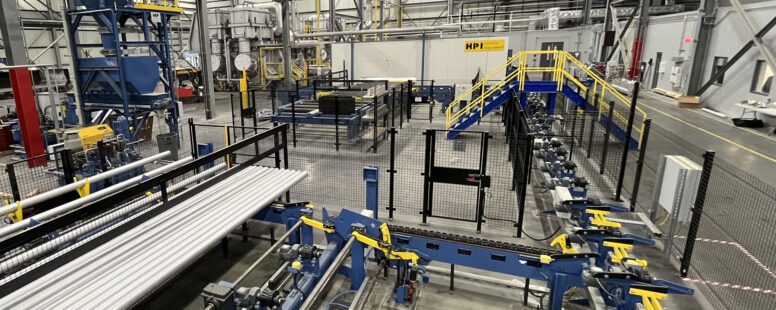
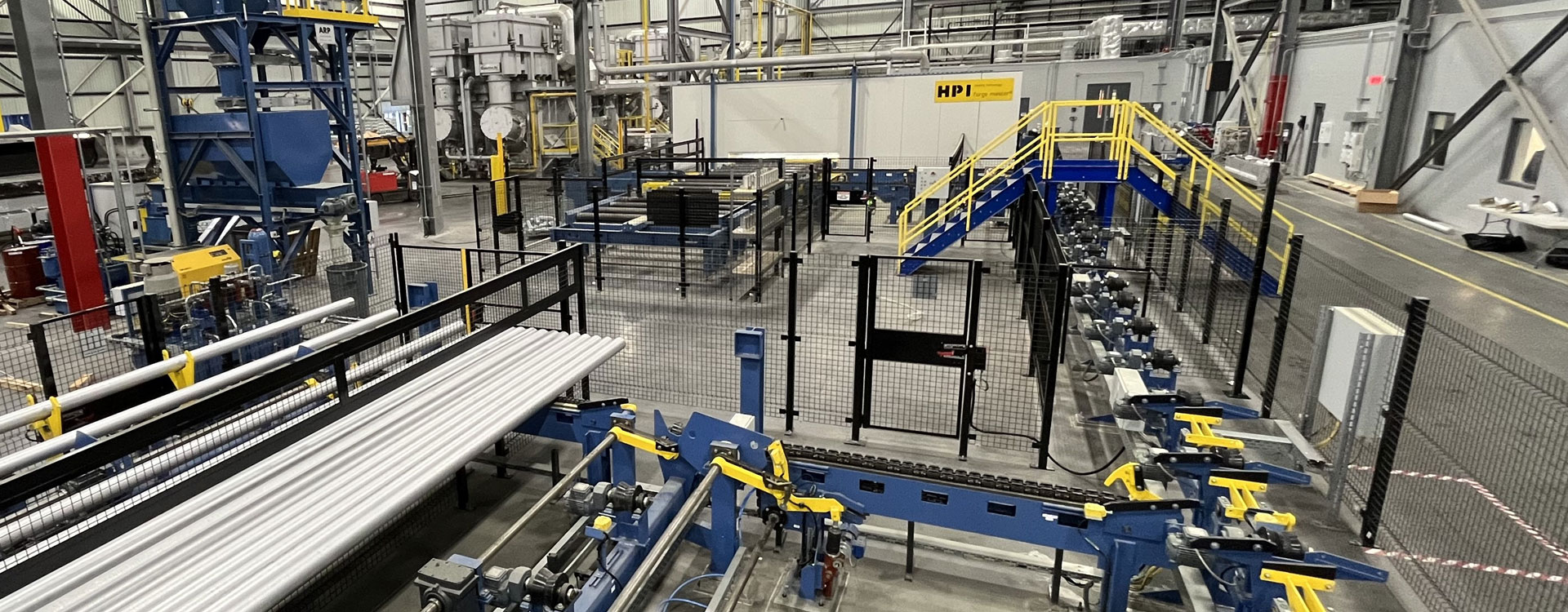
The objective of the project was a complete production line that begins with charging aluminum scrap into the melting furnaces and ends with finished forged components for the automotive industry. HPI’s contribution consisted of supplying the entire casthouse, which produces the finished, inspected, and cut to length billets required for the forging presses.
The customer has now placed the HPI‑supplied casthouse for forging billets into regular operation, representing a key milestone for our client.
INTEGRATED ALUMINUM PRODUCTION: FROM SCRAP TO FORGED AUTOMOTIVE PARTS
From the customer’s perspective, the key challenge was to integrate the entire production process from the delivery of scrap metal through the manufacture of short billets to the finished forged automotive part at a single location.
By combining a casting line with a directly connected forging line, the customer is able to carry out all the process steps required to produce aluminum forged parts entirely “in-house”. This design and arrangement of the process steps allow for consistent production output without the casting process having to be interrupted due to minor irregularities. This is achieved in particular through a generous layout, which provides sufficient buffer capacity for continuous operation.
This not only creates a seamless process chain but also ensures a high level of supply reliability. This is the key advantage for efficiently supplying the American automotive market.
Additionally, the spacious layout also provides operators with a clear overview to monitor the processes.
CLOSED VALUE ADDED CYCLE
Another significant feature of the plant is its closed value-added cycle: All aluminium scrap generated by the process, including slugs and chips, is fed back into the internal production cycle. This increases the efficiency of re-source use, while also contributing to the sustainability of the operation.
MELT MANAGEMENT IN HORIZONTAL CONTINUOUS CASTING
For the first time, HPI was able to implement its decades of experience in horizontal continuous casting within a complete integrated solution.
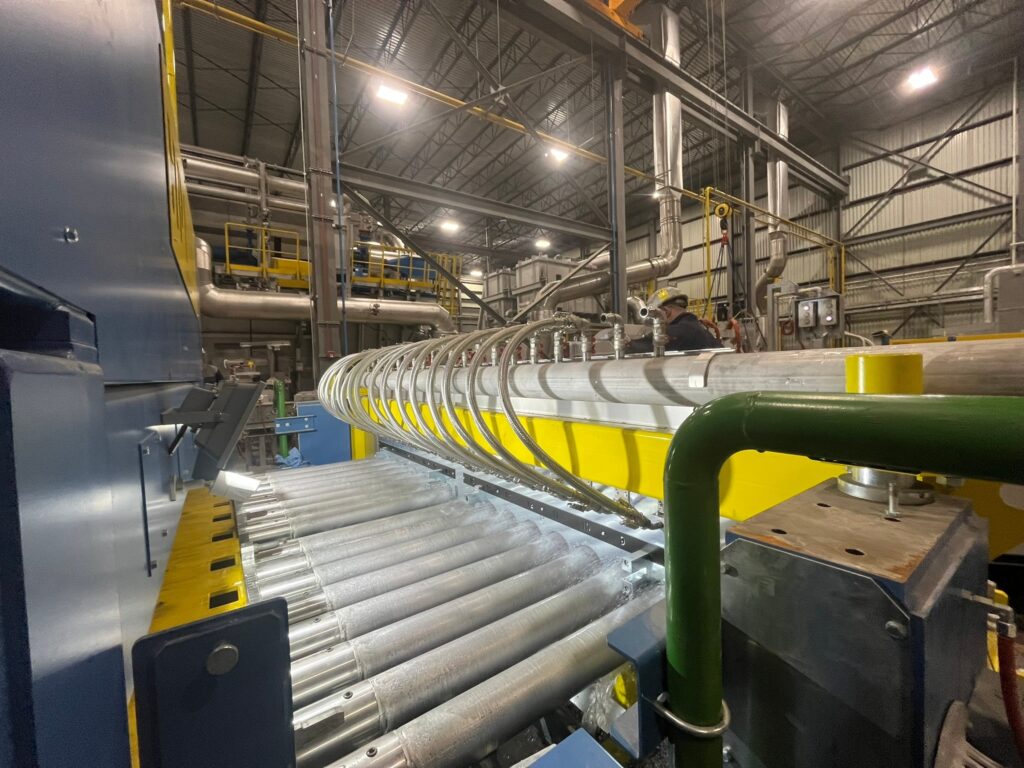
To meet the requirements of horizontal continuous casting, which typically involves lower flow rates of around 3.5 to 5.0 t/h melt, all launder components from the furnace spout onward, including the degasser, rod feeder, and the filter box itself, were newly developed.
This minimized heat losses that would otherwise require overheating the melt in the furnace, which negatively affects metal quality and energy consumption.
The launders consist of a steel shell, microporous insulation, and durable fused silica refractory. All launder elements are additionally equipped with electrically heated lids. Just before the tundish, a T shaped launder segment is used, which enables remote and therefore particularly safe tundish emptying. When necessary, immersion heaters allow targeted temperature adjustments in this area. The so-called “casting start shutter” in this T-piece allows for rapid filling and emptying of the tundish, which is particularly important given the small casting diameters in order to ensure a reliable start.
The highlight of the casting system is the HPI ForgeMaster® mould system, which enables uninterrupted casting sequences of more than 30 hours (e.g. diameter 118 mm, alloy EN AW 6082).
TRACEABILITY, QUALITY AND EFFICIENCY
The facility also sets new benchmarks in quality assurance. Each billet is individually marked and can be traced throughout the entire process, from the first casting step to the final, tested product linked to its process and quality data. Integrated ultrasound testing, combined with state-of-the-art surface inspection methods, allow the quality of each individual aluminum billet to be accurately assessed. If local deviations are detected, the saw only removes the defective area. This ensures that yields are maximized and prevents problems during downstream processing.
The approach reduces manual testing, improves the reproducibility of results and minimizes human error. In turn, this results in consistently high quality, outstanding reliability and efficient processing sequences.
ONE SHARED VISION, ONE STORY OF SUCCESS
The American plant is an example of how international technical collaboration can translate complex ideas into efficient, practical solutions. By integrating both a casting line and a forging line into a single workshop, an optimized and powerful production chain was created, one that is specifically tailored to the needs of the American automotive industry. Both companies are looking forward to future collaborative projects that will both create added value and advance meaningful innovations.
Explore our product portfolio and technologies, and keep current with the latest updates from HPI!