


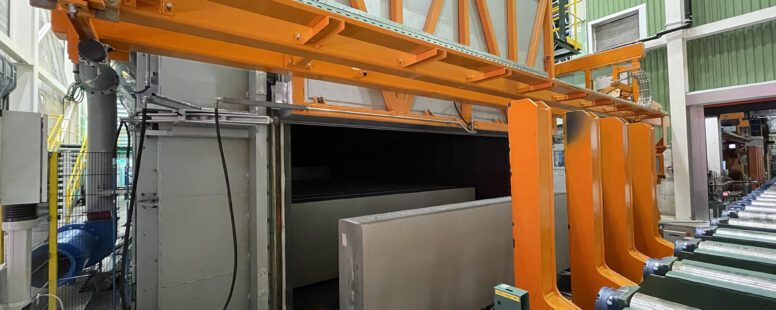
The Electric Pusher Furnace
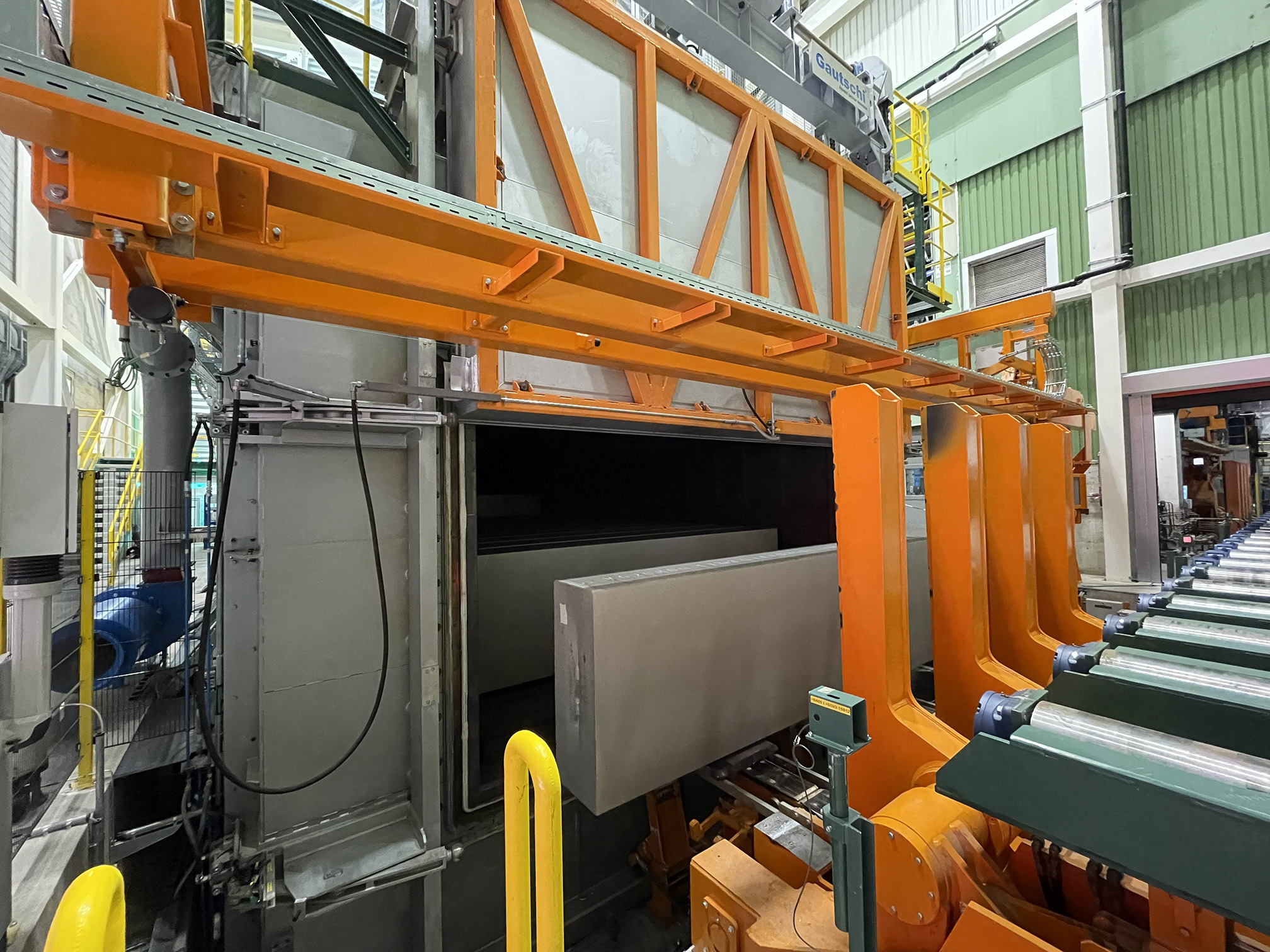
Gautschi | MARUS SCHLAGER, R&D
The Electric Pusher Furnace
A New Benchmark for Sustainable Aluminum Processing.
The metals industry is undergoing a fundamental transformation driven by rising energy costs, tightening environmental regulations, and the global push toward decarbonized production. As gas-fired furnaces face increasing scrutiny due to emissions, volatility in fuel supply, and high operating expenses, producers are turning to electrification as a strategic path forward.
Modern rolling mills and foundries are seeking technologies that not only reduce CO2 emissions but also deliver higher process stability, predictable energy consumption, and long term operational resilience. Against this backdrop, the introduction of EBNER Group’s first electric heated pusher furnace marks a decisive step into the next generation of sustainable and efficient heat treatment systems.
FURNACE DESIGN AND OPERATION
The pusher‑type furnace is the most advanced solution for reheating and homogenizing aluminum ingots in modern rolling mills. Operating in a semi-continuous mode, it delivers exceptional process stability, high throughput, and uniform thermal treatment across all ingot dimensions.
Inside the furnace, the rolling ingots rest on rails inside a tunnel‑shaped chamber and move through the system as a tightly packed charge. Each time a new ingot is introduced, a pushing mechanism advances the entire furnace load by one position. The furnace itself is divided into three separate process zones. First, ingots are preheated in the input zone located at the furnace inlet using hot furnace atmosphere from downstream areas. Second, the ingots enter the heating zone where they are brought up to the desired heat-treatment temperature. Third, the ingots move through the holding zone where complete temperature equalization is ensured before the ingots are transported out of the furnace.
The heat treatment process is fully automated. When the rolling mill requests an ingot, the discharge door opens and a mechanical extraction device pulls the rolling ingot out on its sliding shoes before transferring it to the roller table. The shoes are then placed onto the transport carriage and travel back to the furnace inlet. There, they are repositioned on the rails while
the next rolling ingot is measured, centered, raised, and placed onto them. Once the inlet door opens, a powerful hydraulic cylinder pushes the new ingot into the furnace, advancing the entire furnace charge by one posi-tion. This optimized cycle ensures a smooth production flow and enables the retrieval of an ingot roughly every five to six minutes.
Electric heating elements are installed at the top of the furnace and arranged into different registers, delivering up to 820 kW of power. Four registers per furnace zone provide a total connected load of 10.1 MW. For installation or maintenance, the heat-ing elements can be lifted in or out of the furnace using the overhead crane. Manufactured from high‑resistance heating material, the heating elements offer stepless power control for precise temperature regulation and highly efficient plant operation.
FEATURES AND BENEFITS OF THE EBNER GROUP ELECTRIC PUSHER FURNACE
The primary advantage of electric heating is the significantly higher energy efficiency. Unlike conventional gas fired furnaces, the electric system generates no exhaust gas heat losses. The electric pusher furnace operates as a fully closed system in which the furnace atmosphere is continuously recirculated, minimizing thermal losses and ensuring exceptionally efficient plant performance.
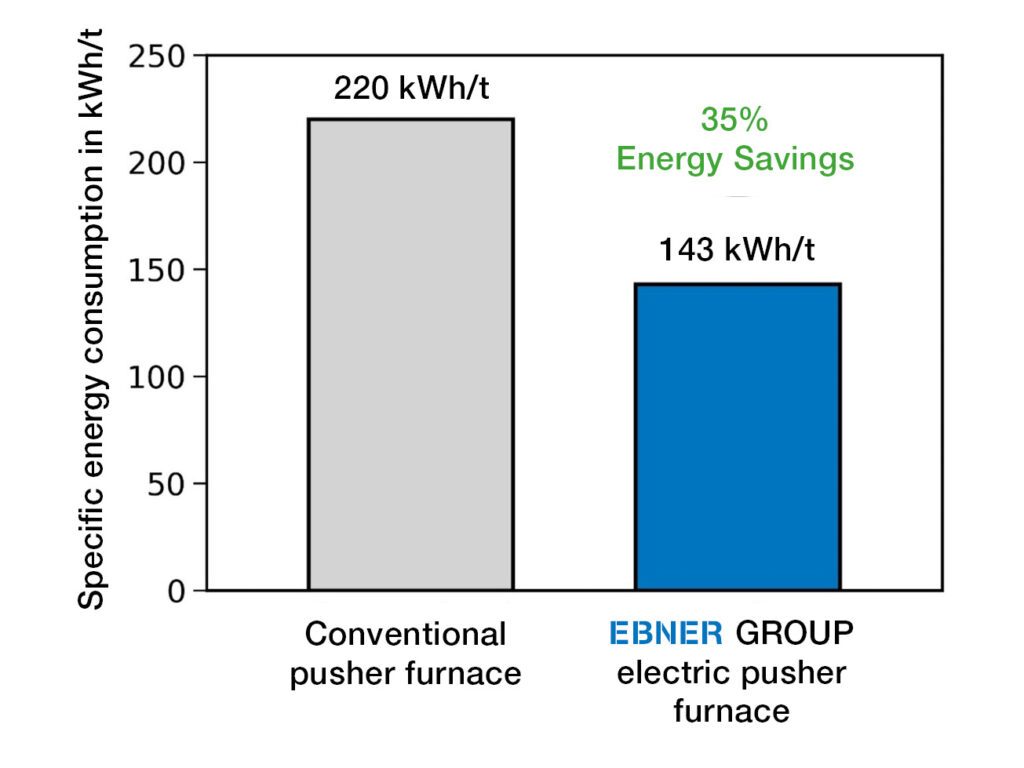
In addition, electric heating elements respond far faster and with greater precision than conventional burners, resulting in superior temperature uniformity and shorter heat‑up times through optimal use of overheat temperature. Thanks to this optimized design, the energy demand for heating and homogenization has been reduced to just 143 kWh/t – representing 35% energy savings compared to conventional pusher furnaces.
Use of electrical heating elements reduces the facility’s complexity and minimizes the number of wear‑prone parts. Electrical heating allows for the removal of several assemblies that require intensive monitoring and upkeep, such as gas trains and pressure regulation units, burner assemblies, combustion air blowers and ducting, flue‑gas ducting, and emission‑control equipment. As a result, the system becomes leaner, more dependable, easier to operate, and easier to maintain.
This leads to the following advantages:
- Shorter planned maintenance shutdowns
- Reduced spare‑parts inventory
- Facility footprint is reduced
- Fewer inspections required
- No burner tuning or periodic combustion optimization
- No combustion residues or soot, resulting in more stable long‑term performance
- Higher furnace availability and lower maintenance costs
OUTLOOK
The introduction of EBNER Group’s first electrically heated pusher furnace marks a decisive technological shift for aluminum rolling mills seeking higher efficiency, lower emissions, and greater operational stability. By combining the proven advantages of pusher‑type furnace design with a fully electric heating system, the solution delivers exceptional energy efficiency, precise thermal control, simplified plant infrastructure, and significantly reduced maintenance requirements. The elimination of combustion‑related components not only minimizes wear and downtime but also creates a cleaner, safer, and more predictable production environment.
Looking ahead, the electric pusher furnace provides a future‑proof platform for the evolving needs of the metals industry. As energy markets continue to shift and decarbonization targets become more stringent, electrically heated systems will play an increasingly vital role in sustainable heat‑treatment operations. With the ability to operate entirely on renewable electricity, the furnace enables rolling mills to reduce their CO2 footprint and align with long‑term corporate sustainability strategies.
TECHNICAL SPECIFICATIONS FURNACE CAPACITY
| Parameter | Value |
| max. ingot dimensions | 4.850 x 2.330 x 540 mm |
| max. ingot mass | 15 t |
| max. furnace capacity | 450 t |
| max. number of ingots | 30 |
MAIN PROCESS PARAMETERS
| Parameter | Value |
| Number of zones | 5 |
| Throughput during unloading | 150 t/h |
| Approximate cycle time | approx. 6 min |
| max. furnace temperature | 680 °C |
| Total electric heater power | 10,1 MW |
| CO2-emissions | No direct CO2-emissions |
| NOx-emissions | No direct NOx-emissions |
PERFORMANCE TEST RESULTS
| Parameter | Value |
| Heating time | 480 min |
| Specific energy consumption | 143 kWh/t |
| Temperature uniformity | ± 2,5 °C |
| Average shell temperature for 540 °C process | < 45 °C |