


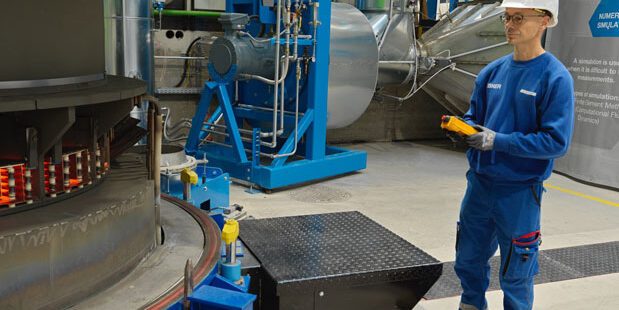
The future of heat treatment
EBNER Industrieofenbau | Sascha Eppensteiner, Vice President Product Management
The future of heat treatment: how GREENBAFx® is revolutionizing the steel industry
The steel industry is under considerable pressure to transform: calls for climate-friendly production processes are growing louder, legal requirements are increasing, and energy efficiency is more than ever a factor in economic success. With GREENBAFx®, EBNER presents a revolutionary bell furnace system that provides answers to precisely these challenges.
Thanks to direct electric heating, integrated heat recovery, and a newly developed passive process bell, the plant combines maximum energy efficiency with zero emissions – and significantly simplified operation.
In this interview, you will learn how the GREENBAFx® works, what advantages it offers over conventional bell furnace systems, how companies can benefit from CO₂ savings and subsidy programs – and why this technology represents an important step toward climate-neutral steel processing.
Could you give us a brief overview of what GREENBAFx® is?
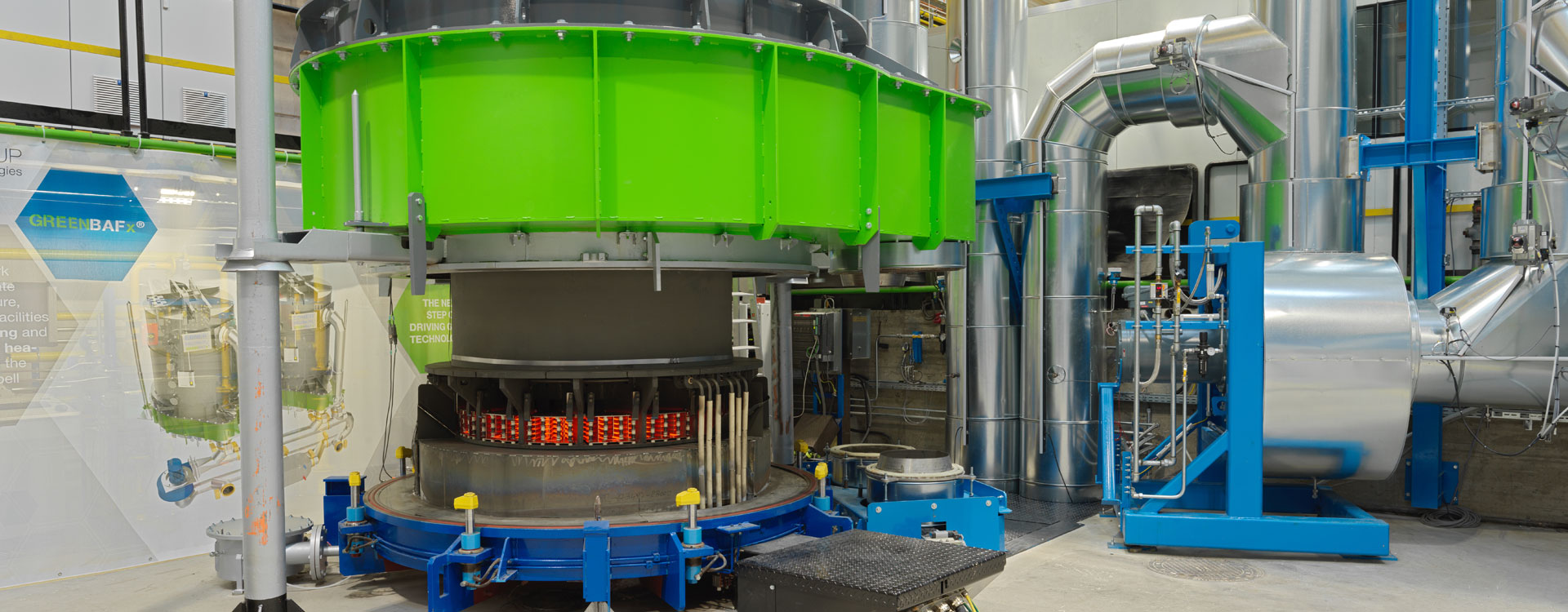
GREENBAFx® is the next generation of bell annealer facilities.
During development, an emphasis was placed on maximizing energy efficiency, eliminating emissions and simplifying operating sequences.
Using a powerful electric heating system integrated into the workbase, energy is transferred directly from the heating system to the process atmosphere.
A process bell, which replaces the traditional heating bell, cooling bell and inner cover, is used throughout the entire process and does not need to be exchanged.
Thermal energy collected during the cooling phase can be exchanged between workbases and used to preheat a cold charge stack.
A really revolutionary design!
What was the main motivation behind the development of this new technology?
EBNER is committed to sustainability. Our motivations were thus to make our facilities fit to face the future, to fulfill future climate-related and environmental regulations, and to provide our customers with a competitive “green” product that helps them achieve their goals.
What makes a GREENBAFx® different from traditional bell annealer facility designs?
The innovative method of heating. In this design, an electric heating system with a high power density is integrated into the workbase itself.
We call this a direct heating system. When compared to the standard types of heating systems employed in bell annealers, several steps of the heat transfer process are eliminated and energy is transferred directly from the heating system to the process atmosphere.
Another central element in the design is the process bell, which replaces the heating bell, inner cover and cooling bell of a normal facility. This greatly simplifies operations at the bell annealer facility, as there is no need to exchange heating and cooling bells.
The process bell is also tied into a heat exchange circuit, which transfers thermal energy from one workbase to another. This significantly increases energy efficiency. Energy savings of up to 30 % can be achieved.
The heat exchange system can provide energy savings of up to 30 %. How does it work?
During the cooling phase, high-velocity air is fed into the process bell through a duct. The high velocity ensures that excellent heat transfer is achieved.
The air, now heated to a high temperature, then flows into an insulated heat exchange circuit. Automated dampers lead it to a different process bell, which is standing ready on another workbase. The heated air is circulated under this second process bell in the same way, heating the cold charge. The air, now cool, then flows back to the process bell with the hot charge. It absorbs more thermal energy, after which it transports the energy back to the process bell with the cold charge.
Over the running time of this heat exchange process, the cold charge can be preheated by an amount that provides up to 30 % energy savings.
How does a “passive” process bell improve operating efficiency?
As the process bell replaces the traditional heating bell, cooling bell and inner cover, the operation of the bell annealer facility is greatly simplified.
The process runs fully automatically, from the time the process chamber is clamped (sealed) to the time the clamping system is released.
When a process bell is in use, only two crane movements are needed – one when the process bell is placed, and one when it is lifted off the workbase. In a standard bell annealer facility design, six crane movements would be required.
The process bell is a “passive” bell, without attached devices and without utility couplings.
What role does the electric heating system play in saving energy?
As the heating system is installed directly in the workbase, heat is transferred directly to the process atmosphere.
In traditional bell annealer designs, the heating bell is operated at an overshoot temperature and transfers heat to an inner cover. Underneath the inner cover the heat is transferred a second time, as it moves from the inner wall of the cover to the process atmosphere.
In the new design, there is only one rather than three transfers of heat. Together with reductions in heat losses (no heating bell overshoot temperature is required, and the furnace throat can be fully insulated), these features make the system extremely energy efficient.
Sascha Eppensteiner, Vice President Product Management
How does GREENBAFx® contribute to the decarbonization of the steel industry?
GREENBAFx® operates with zero emissions from the facility, i.e. CO₂ and NOx emissions are completely eliminated.
Furthermore, in combination with the heat exchange system the consumption of electrical energy is significantly reduced.
Which technical solutions does GREENBAFx® employ to reduce energy consumption and emissions?
As the use of an electric heating system means that there is no combustion, there are no exhaust products like CO2 or NOx.
Energy consumption is also reduced by transferring energy directly (direct heating), and by using thermal energy collected during cooling to preheat a cold charge stack (heat exchange).
Are there subsidies or regulatory benefits for companies that switch to GREENBAFx®?
In carbon-intensive industries, as for example steel manufacturing, emissions certificates are cost drivers.
Heat treatment at a GREENBAFx® facility emits no local CO₂, and it follows that significantly fewer certificates are required for the overall process. Ideally, the electric heating system would be powered with green electricity.
Due to its high energy efficiency and lack of emissions, a GREENBAFx® can qualify for subsidies. Many nations have programs that subsidize investments in climate-friendly production equipment.
Have there been pilot projects or initial installations that have been successful?
For more than one and a half years, a pilot facility has been operating at an innovative customer’s works. This has allowed us to test the performance of the equipment, particularly that of the integrated electric heating system, in an industrial environment.
This kind of partnership is crucial for collecting long-term production experience and rapidly recognizing any “teething troubles” that may appear.
In the steel industry, how will heat treatment develop over the next 10 years?
Heat treatment is facing a profound transformation and will undergo major changes over the next 10 years. The major drivers of change will be decarbonization, digitalization, and energy efficiency.
Now that the steel industry’s major projects to decarbonize upstream processes are underway, the decarbonization of downstream processes – which include heat treatment – will follow.