


Efficient homogenization with state-of-the-art technology
EBNER Industrieofenbau | Markus Gangl, Senior Product Manager Aluminum
Efficient homogenization with state-of-the-art technology
The path of an ingot into the rolling mill.
Aluminum is one of the most versatile metals of our time: its light weight and strength make it indispensable in sectors like the automotive, aerospace and packaging industries. However, before a cast rolling ingot can enter the rolling mill, the microstructure within it must be perfectly prepared. This is where homogenizing heat treatment comes in: homogenization is a crucial processing step that reduces stresses, refines the microstructure and ensures that the quality of the material is uniform.
For decades, EBNER Industrieofenbau has been developing extremely precise furnace systems that carry out this process economically, reproducibly and with a high degree of energy efficiency. In the following interview, Markus Gangl, Senior Product Manager Aluminum, explains which furnace designs are used to fulfill which of the aluminum industry’s requirements and how innovation and efficiency can be paired to create the heat treatment processes of the future.
Why is heat treatment so important to the rolling process for aluminum?
An aluminum ingot is very inhomogeneous after it is cast, with stresses and coarse segregation found throughout its structure. To ensure that material properties are uniform throughout the entire ingot, as well as to ensure that all the stresses are relieved, a homogenizing anneal must be carried out. The material is evenly heated until it is just below its melting point (from around 450 °C to around 620 °C, depending on the alloy) and maintained at that temperature for a certain amount of time. This eliminates the stresses, reduces segregation, removes intermetallic phases and improves ductility.
EBNER offers a number of different furnace designs. Can you give us an overview of what each type is used for?
The alloys in the 2xxx and 7xxx series, which are particularly hard and are used in the aerospace industry, tend to burst after they are cast due to the stresses that form in the ingot. For this reason, it is crucial to homogenize them as quickly as possible. An excellent solution for this application is to use a batch-type furnace for ingots or a car bottom furnace, with the best approach being to place the furnace near the casthouse. This reduces the time and distance between casting and homogenization.
For an all-rounder suitable for homogenizing any alloy or for bringing already-homogenized ingots up to hot rolling temperature, the pusher furnace is an established option. Its high efficiency and high throughput are very useful for dealing with high production volumes.
Finally, for customers that need the flexibility to handle smaller batch sizes and a wide range of alloys, an EBNER FlexBatch furnace is the best solution.
A HICON® pusher furnace is the centerpiece of many rolling mills. What advantages does it offer, particularly for larger ingots?
Thanks to an optimized jet nozzle system, the precision with which atmosphere flow is directed between the ingots and the even distribution of the atmosphere in circulation, a pusher furnace is the most efficient method of heating. When combined with HICON® fans, which are capable of recirculating high volumes of gas, the speed of the gas flow at the jet nozzles is extremely high. This increases the convective transfer of thermal energy to the ingots. In comparison to other systems, this leads to shorter heating-up times and reduces energy consumption.
Surface defects are an important issue. How do inclined and spaced rolls prevent damage to ingots?
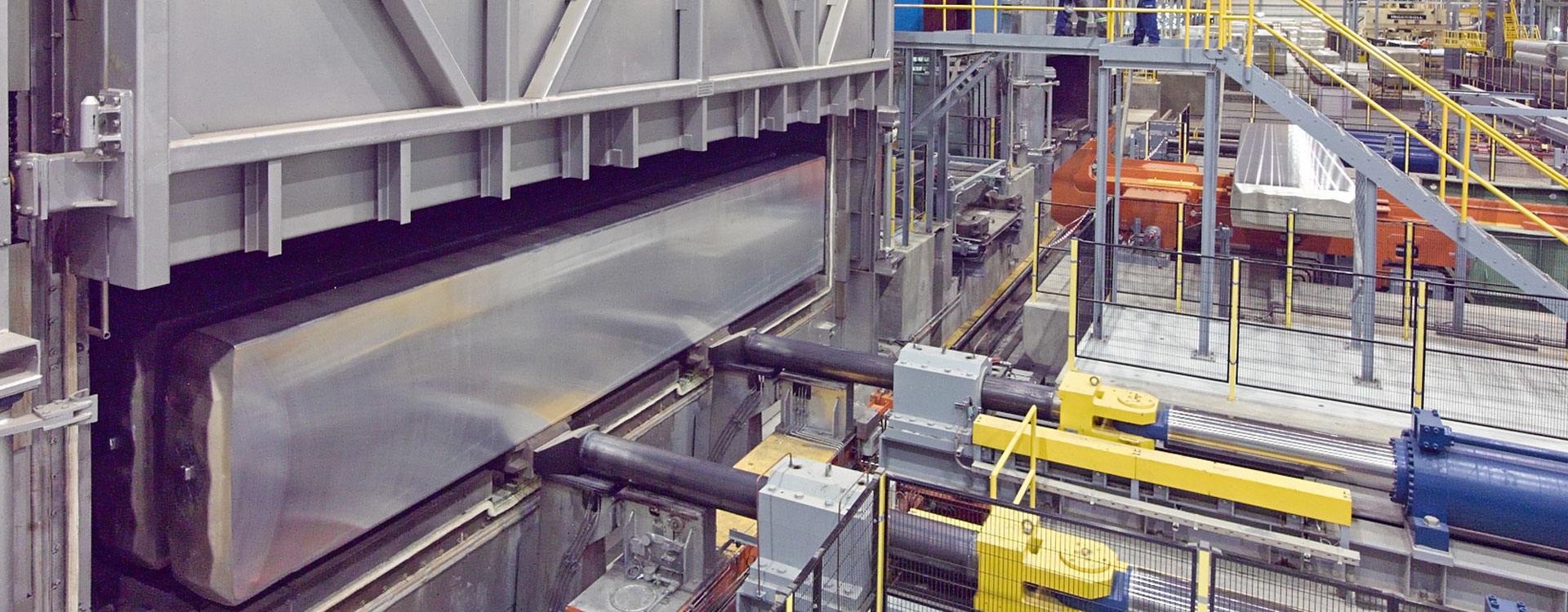
Due to the fact that throughout the entire process – from when the material is charged to when it is transferred to the rolling mill roller table – the EBNER ingot handling system only comes into contact with the edges of ingots, there is no contact with or damage to sensitive rolling surfaces.

A FlexBatch furnace is designed to handle vertical ingots. Compared to traditional furnace solutions, what advantages does this design provide customers?
Like a pusher furnace, a FlexBatch furnace employs optimized jet nozzles and a directed flow of atmosphere between vertically-oriented (standing) ingots. However, there are multiple independent furnace chambers, each of which can contain 4 to 6 ingots. This provides a great deal of flexibility for customers processing smaller quantities of identical ingots, and this flexibility is combined with the excellent efficiency of a pusher furnace.
Whether a batch-type furnace, a car bottom furnace, a pusher furnace or a FlexBatch furnace, every EBNER system is designed to carry out a homogenizing process accurately, efficiently and economically. With state-of-the-art atmosphere flow technology, intelligent control systems and designs that optimize energy use, EBNER is setting new standards for the heat treatment of aluminum ingots.
To learn more about our furnace technologies for the aluminum industry:
Pusher furnace | FlexBatch furnace | Batch and car bottom furnaces